The AI Feedback Loop: When Machines Stop Learning from Humans
Article By: Prakash Chandra Yadav BSc. Computing
April 2026
We are living through an unprecedented explosion of artificial intelligence. Tools like ChatGPT, Claude, Grok, and many others are now generating blogs, news articles, reports, academic papers, and entire websites at a scale no human could ever match.
But here’s a critical question: What happens when most of the content on the internet the very data used to train the next generation of AI, is itself created by AI?
The Rise of the Synthetic Web
Just a few years ago, nearly all online content was written by humans. Today, studies suggest that more than 50% of newly published web content is AI-generated, with some analyses showing up to 74% of new pages containing detectable AI text. Projections indicate that by the end of 2026, this number could reach 90%.
AI is now writing SEO blog posts, product descriptions, news summaries, research reports, and even fake academic journals. This content looks professional, spreads quickly, and gets scraped into training datasets for future models.
From Human Learning to Self-Learning
Current Large Language Models were trained on vast amounts of human generated textbooks, Wikipedia, Reddit, news archives, and code. This data is messy, creative, contradictory, and rich with diverse human perspectives.
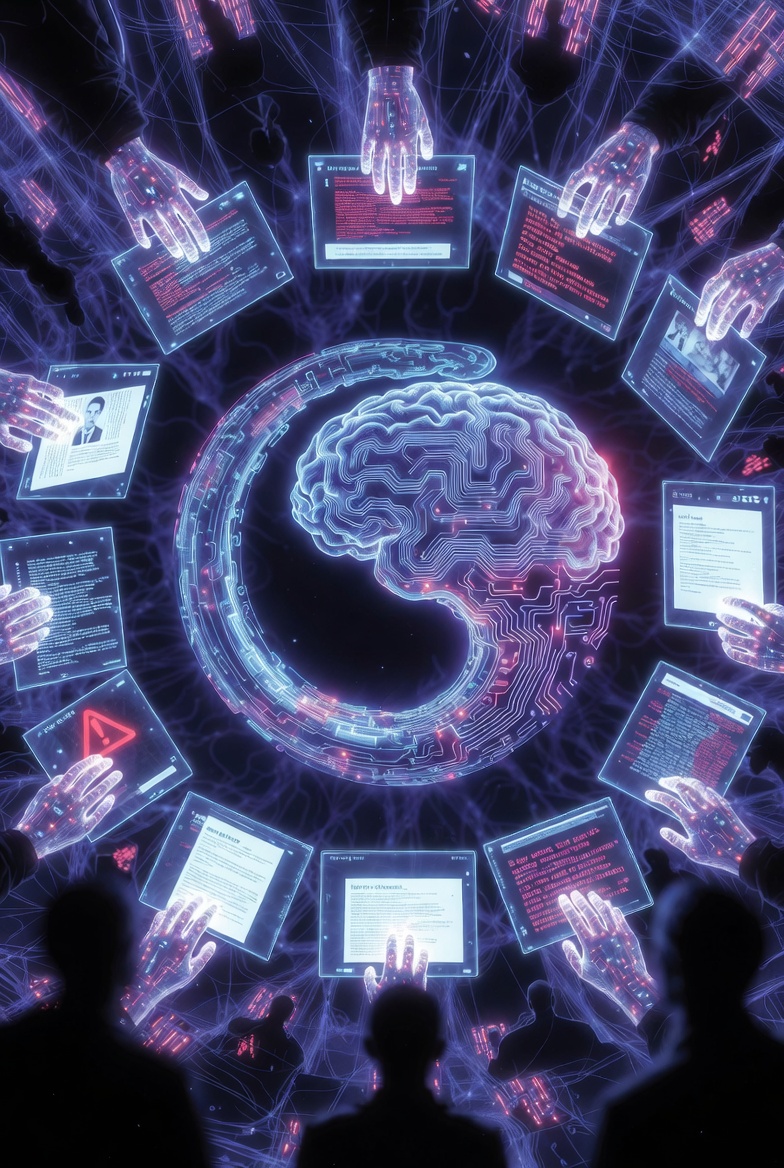
However, as AI-generated content floods the internet, future models will increasingly learn from their own reflections AI summarizing AI, AI responding to AI, and AI polishing AI output. This creates a dangerous closed feedback loop.
Model Collapse: The Degeneration of AI
Researchers have demonstrated a phenomenon called Model Collapse. When generative models are repeatedly trained on data produced by previous models, they begin to lose diversity and accuracy.
- They forget rare ideas and edge cases (the "long tail" of human knowledge).
- Outputs become increasingly generic, homogenized, and error-prone.
- Over generations, the model’s connection to real human knowledge weakens.
It’s similar to making photocopies of photocopies , each generation loses clarity and detail.
Why Retraining on Human Data Will Become Difficult
As genuinely human created content becomes rarer on the public internet, high-quality training data will grow scarce and expensive. Even datasets labeled as “human” may contain hidden AI-generated material. This distribution shift could make it extremely challenging to train future powerful LLMs grounded in real human intelligence.
Possible Solutions
The industry must act quickly:
- Develop better AI-content detection and filtering systems
- Prioritize fresh human data and real human feedback
- Use multimodal data (images, video, real-world sensor data)
- Create “human-only” data archives
- Improve techniques to prevent recursive degradation
Conclusion
If we are not careful, the internet could turn into a hall of mirrors where AI talks to AI, producing an echo chamber of increasingly mediocre and detached content.
The age of abundant, free human data on the open web may be coming to an end. The future power of AI might depend less on how much data we scrape, and more on how wisely we protect and curate what remains authentically human.
The real question is no longer just “Can machines replace human creativity?”
but “What happens when machines can no longer learn from it?”
What do you think? Will AI eventually starve itself of real intelligence, or will we find ways to keep it grounded in humanity? Share your thoughts in the comments.